CODE COMPLIANCE
COMPLIANT WITH KEY SAFETY CODES:
IBC/IFC & Applicable Codes
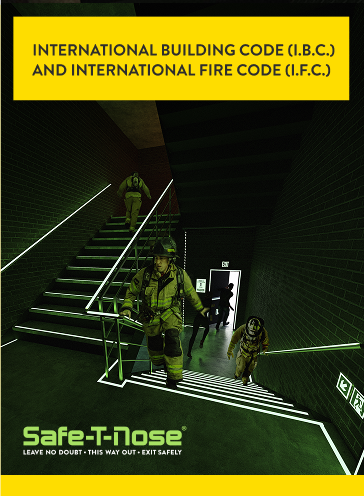
This document provides guidance to local building officials, architects, and contractors as to the requirements for luminous egress path markings in new and existing high-rise buildings, in accordance with the 2021 International Building and Fire codes.
Compliance with these code sections will ensure a safe evacuation of residents during emergency conditions-potentially saving lives in the process.
DOWNLOADS
Product Legend
Steps
Landings
Handrails
Wall-Mounted
Floor-Mounted
Transition
Obstacles
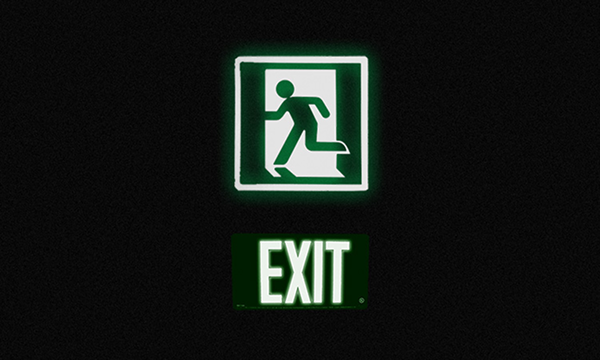
Emergency Exit Symbol
Door hardware Markings
Door Frame Markings
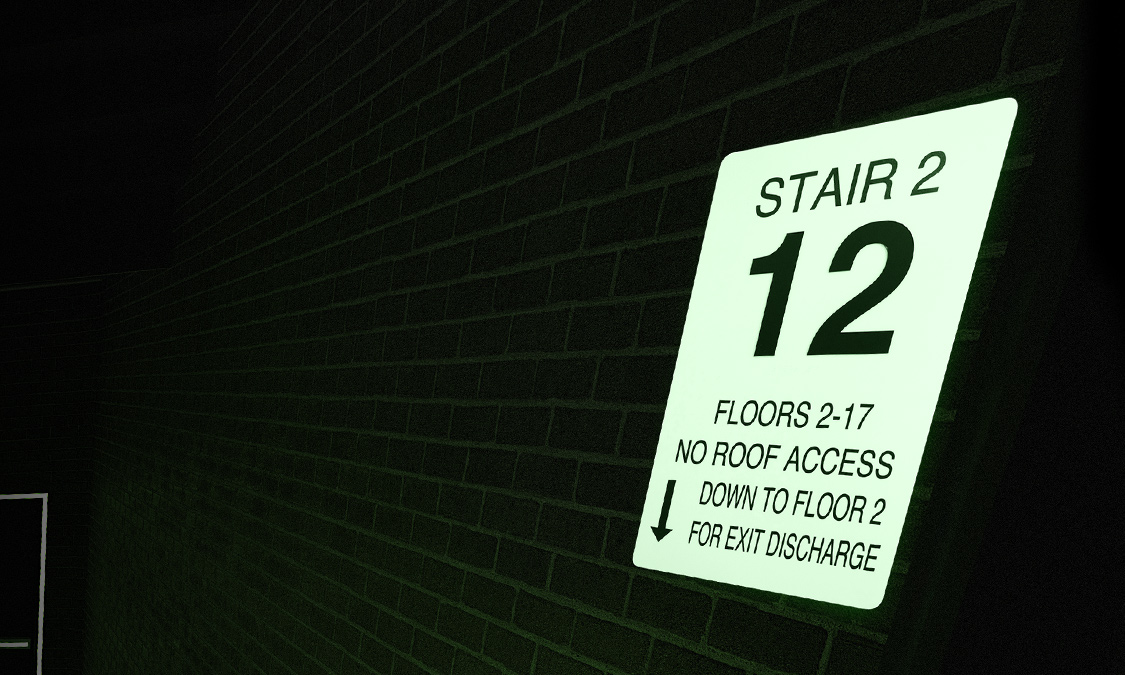
Stairway Identification Signage
Internally Illuminated Exit Signs
GENERAL
Approved luminous egress path markings delineating the exit path shall be provided in high-rise buildings of Groups A, B, E, I-1, M or R-1 occupancies in accordance with this section.
Exception: Luminous egress path markings shall not be required on the level of exit discharge in lobbies that serve as part of the exit path in accordance with Section 1028.1, Exception 1.
1025.2 MARKINGS WITHIN EXIT COMPONENTS
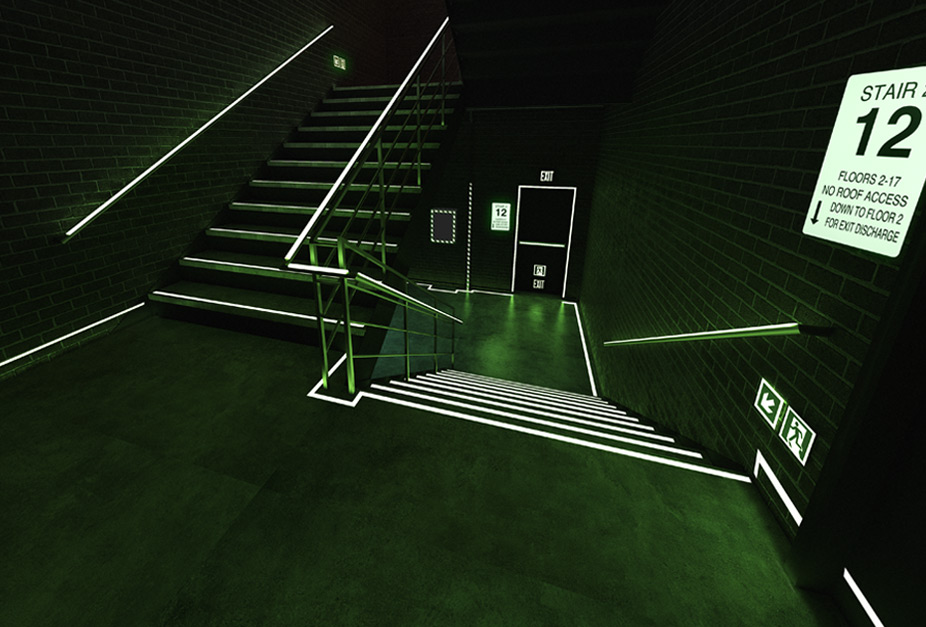
Egress path markings shall be provided in interior exit stairways, interior exit ramps and exit passageways, in accordance with Sections 1025.2.1 through 1025.2.6.
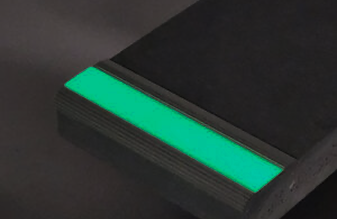
1025.2.1 STEPS
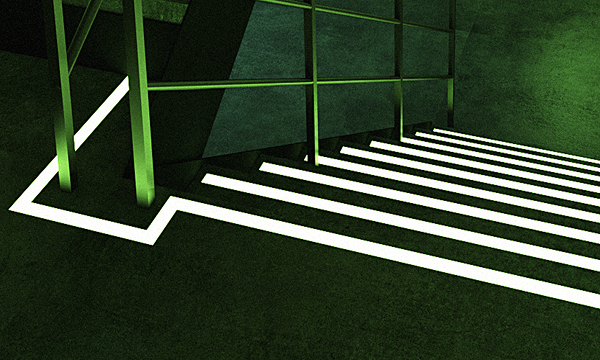
A solid and continuous stripe shall be applied to the horizontal leading edge of each step and shall extend for the full length of the step. Outlining stripes shall have a minimum horizontal width of 1 inch (25 mm) and a maximum width of 2 inches (51 mm). The leading edge of the stripe shall be placed not more than 1/2 inch (12.7 mm) from the leading edge of the step and the stripe shall not overlap the leading edge of the step by not more than 1/2 inch (12.7 mm) down the vertical face of the step.
Exception: The minimum width of 1 inch (25 mm) shall not apply to outlining stripes listed in accordance with UL 1994.
1025.2.2 LANDINGS
The leading edge of landings shall be marked with a stripe consistent with the dimensional requirements for steps.
1025.2.3 HANDRAILS
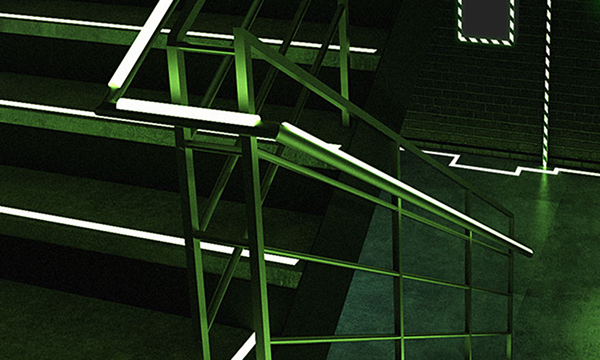
Handrails and handrail extensions shall be marked with a solid and continuous stripe having a minimum width of 1 inch (25 mm). The stripe shall be placed on the top surface of the handrail for the entire length of the handrail, including extensions and newel post caps. Where handrails or handrail extensions bend or turn corners, the stripe shall not have a gap of more than 4 inches (102 mm).
Exception: The minimum width of 1 inch (25 mm) shall not apply to outlining stripes listed in accordance with UL 1994.
1025.2.4 PERIMETER DEMARCATION LINES
Stair landings and other floor areas within interior exit stairways, interior exit ramps and exit passageways, with the exception of the sides of steps, shall be provided with solid and continuous demarcation lines on the floor or on the walls or a combina- tion of both. The stripes shall be 1 to 2 inches (25 mm to 51 mm) wide with interruptions not exceeding 4 inches (102 mm).
Exception: The minimum width of 1 inch (25 mm) shall not apply to outlining stripes listed in accordance with UL 1994.
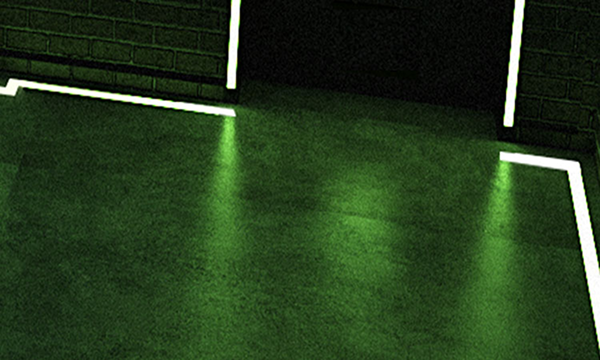
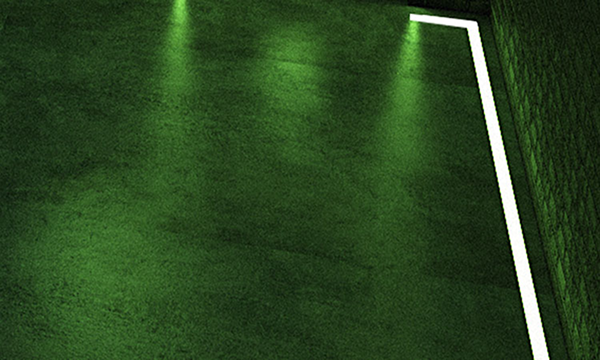
1025.2.4.1 FLOOR-MOUNTED DEMARCATION LINES
Perimeter demarcation lines shall be placed within 4 inches (102 mm) of the wall and shall extend to within 2 inches (51 mm) of the markings on the leading edge of landings. The demarcation lines shall continue across the floor in front of all doors.
Exception: Demarcation lines shall not extend in front of exit discharge doors that lead out of an exit and through which occupants must travel to complete the exit path.
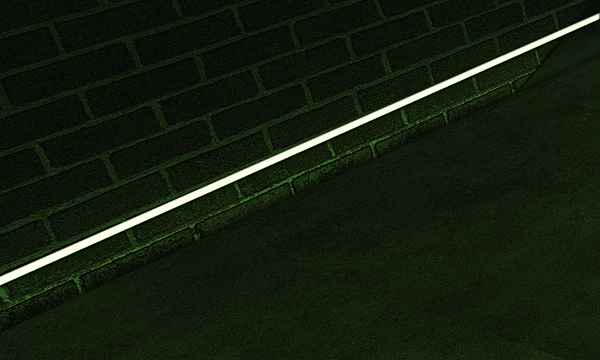
1025.2.4.2-WALL-MOUNTED
Perimeter demarcation lines shall be placed on the wall with the bottom edge of the strips not more than 4 inches above the finished floor. At the top or bottom of thestairs, demarcation lines shall drop vertically to the floor within 2 inches of the step or landing edge. Demarcation lines on the wall shall transition vertically to the floor and then extend across the floor where a line on the floor is the only practical method of outlining the path. Where the wall line is broken by a door, demarcation lines on wall shall continue across the face of the door or transition the floor and extend across the floor in front of such door.
1025.2.4.3 TRANSITION
Where a wall-mounted demarcation line transitions to a floor-mounted demarcation line, or vice versa, the wall-mounted demarcation line shall drop vertically to the floor to meet a complimentary extension of the floor-mounted demarcation line, thus forming a continuous marking.
1025.2.5 OBSTACLES
Obstacles at or below 6 feet 6 inches (1981 mm) in height and projecting more than 4 inches (102 mm) into the egress path shall be outlined with markings not less than 1 inch (25 mm) in width comprised of a pattern of alternating equal bands, of luminous material and black, with the alternat- ing bands not more than 2 inches (51 mm) thick and angled at 45 degrees (0.79 rad). Obstacles shall include, but are not limited to, standpipes, hose cabinets, wall projections and restricted height areas. However, such mark- ings shall not conceal any required information or indicators including but not limited to instructions to occupants for the use of standpipe

1025.2.6 DOORS WITHIN THE EXIT PATH
Obstacles at or below 6 feet 6 inches (1981 mm) in height and projecting more than 4 inches (102 mm) into the egress path shall be outlined with markings not less than 1 inch (25 mm) in width comprised of a pattern of alternating equal bands, of luminous material and black, with the alternat- ing bands not more than 2 inches (51 mm) thick and angled at 45 degrees (0.79 rad). Obstacles shall include, but are not limited to, standpipes, hose cabinets, wall projections and restricted height areas However, such markings shall not conceal any required information or indicators including but not limited to instructions to occupants for the use of standpipes.
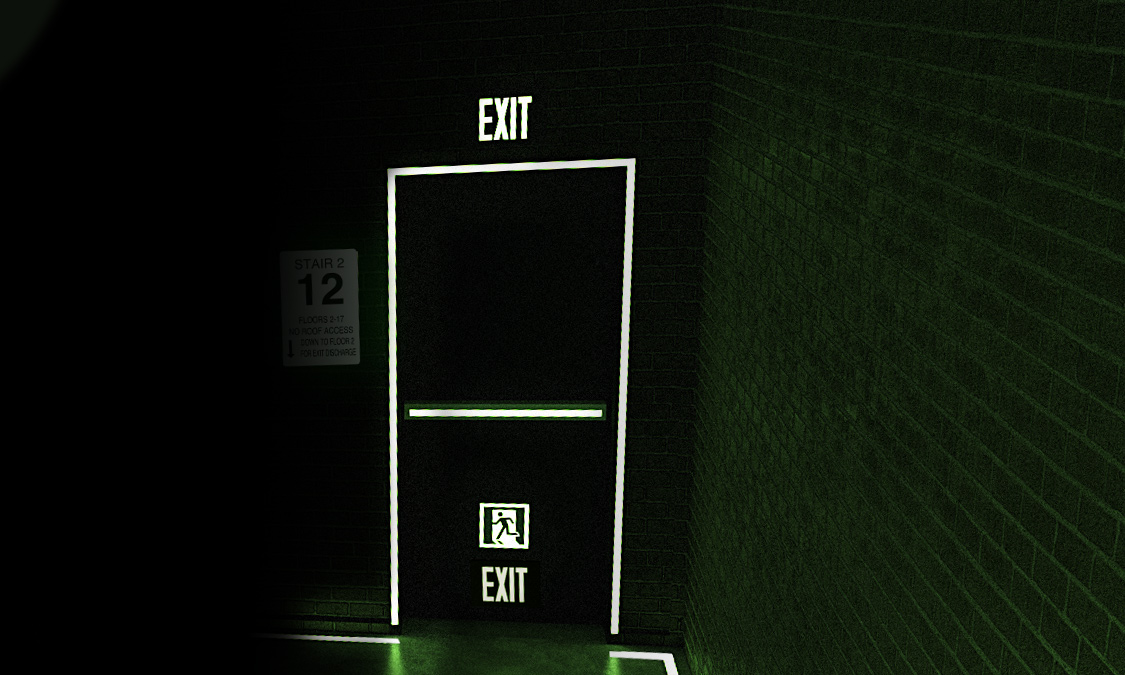
1025.2.6.1 EMERGENCY EXIT SYMBOL
The doors shall be identified by a low-location luminous emergency exit symbol complying with NFPA 170. The exit symbol shall be not less than 4 inches (102 mm) in height and shall be mounted on the door, centered horizontally, with the top of the symbol not higher than 18 inches (457 mm) above the finished floor.
1025.2.6.2 DOOR HARDWARE MARKINGS
Door hardware shall be marked with not less than 16 square inches (406 mm2) of luminous material. This marking shall be located behind, immediately adjacent to, or on the door handle or escutcheon. Where a panic bar is installed, such material shall not be less than 1 inch (25 mm) wide for the entire length of the actuating bar or touchpad.
1025.2.6.3 DOOR FRAME MARKINGS
The top and sides of the door frame shall be marked with a solid and continuous 1-inch- to 2-inch-wide (25 mm to 51 mm) stripe. Where the door molding does not provide sufficient flat surface on which to locate the stripe, the stripe shall be permitted to be located on the wall surrounding the frame.
1025.3 UNIFORMITY
Placement and dimensions of markings shall be consistent and uniform throughout the same enclosure.
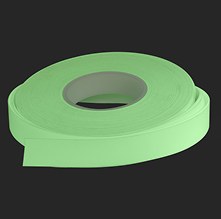
1025.4 SELF-LUMINOUS AND PHOTOLUMINESCENT
Luminous egress path markings shall be permitted to be made of any material, including paint, provided that an electrical charge is not required to maintain the required luminance. Such materials shall include, but not be limited to, self-luminous materials and photoluminescent materials. Materials shall comply with either of the following standards:
- UL 1994.
- ASTM E2072, except that the charging source shall be 1 footcandle (11 lux) of fluorescent illumination for 60 minutes, and the minimum luminance shall be 30 milicandelas per square meter at 10 minutes and 5 milicandelas per square meter after 90 minutes.
Photo-Glo® STNF
Premium Extruded Polymer
Photo-Glo® S9203
Budget Acrylic Vinyl
1025.5 ILLUMINATION
Where photoluminescent exit path markings are installed, they shall be provided with not less than 1 footcandle (11 lux) of illumination for not less than 60 minutes prior to periods when the building is occupied and continuously during occupancy.
2018 IFC/IBC 1023.9 STAIRWAY IDENTIFICATION SIGNS
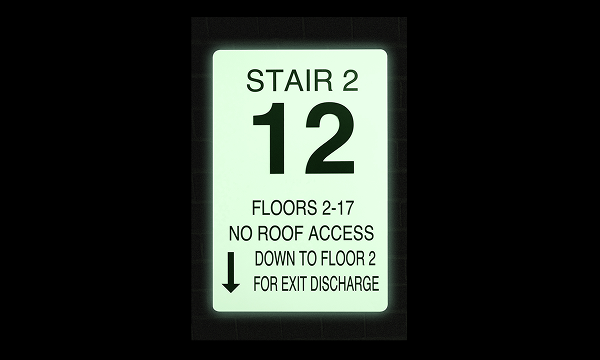
A sign shall be provided at each floor landing in an interior exit stairway and ramp connecting more than three stories designating the floor level, the terminus of the top and bottom of the interior exit stairway and ramp and the identification of the stairway or ramp. The signage shall state the story of and direction to the exit discharge, and the availability of roof access from the interior exit stairway and ramp for the fire department. The sign shall be located 5 feet (1524 mm) above the floor landing in a position that is readily visible when the doors are in the open and closed positions. In addition to the stairway identification sign, a floor-level sign in visual characters, raised characters and braille complying with ICC A117.1 shall be located at each floor-level landing adjacent to the door leading from the interior exit stairway and ramp into the corridor to identify the floor level.
1023.9.1 SIGNAGE REQUIREMENTS
- The signs shall be a minimum size of 18 inches (457 mm) by 12 inches (305 mm).
- The letters designating the identification of the interior exit stairway and ramp shall be not less than 11/2 inches (38 mm) in height.
- The number designating the floor level shall be not less than 5 inches (127 mm) in height and located in the center of the sign.
- Other lettering and numbers shall be not less than 1 inch (25 mm) in height.
- Characters and their background shall have a nonglare finish. Characters shall contrast with their background, with either light characters on a dark background or dark characters on a light background.
- Where signs required by Section 1023.9 are installed in the interior exit stairways and ramps of buildings subject to Section 1025, the signs shall be made of the same materials as required by Section 1025.4.
1013.5 INTERNALLY ILLUMINATED EXIT SIGNS
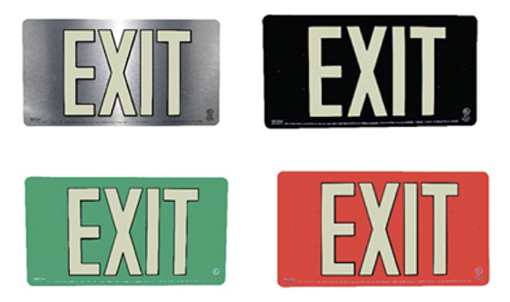
Electrically powered, self-luminous, and photo-lumines- cent exit signs shall be listed and labeled in accordance with UL 924 and shall be installed in accordance with the manufacturer’s instructions and Chapter 27. Exit signs shall be illuminated at all times.
STATE SPECIFIC REQUIREMENTS - NYC
New York City models the national codes – I.B.C. / I.F.C.
New York City has been a leader in adoption of luminous egress path marking. In addition to the national model code, NYC requires additional signage, product labeling and a TR7 form filed stating all was completed to code requirements.
- PDF: TR7 LUMINOUS EGRESS PATH MARKINGS REPORT
- PDF: NYC APPENDIX S PHOTOLUMINESCENT
STATE SPECIFIC REQUIREMENTS - CALIFORNIA
In addition to adoption of the national model code, California enforces the ADA contrasting stripe 2” top and bottom of each run of stairs.
They must be safety yellow if stair is considered outside.
Sometimes the parking garage under the high rise would be considered exterior, and therefore safety yellow markings are required.
STATE SPECIFIC REQUIREMENTS - LAS VEGAS
In addition to adoption of the national model code, Las Vegas defines a high rise building as 55 feet above grade, the I.B.C. defines a high rise building as 75 feet above grade.
STATE SPECIFIC REQUIREMENTS - LOS ANGELES
In addition to the adoption of the national model code, Los Angeles enforces ADA code 11B-504.4.1 Contrasting Stripe.
Interior stairs shall have the upper approach and lower tread marked by a stripe providing clear visual contrast. Exterior stairs shall have the upper approach and all treads marked by a stripe providing clear visual contrast.
The stripe shall be a minimum of 2 inches (51 mm) wide to a maximum of 4 inches (102 mm) wide placed parallel to, and not more than 1 inch (25 mm) from, the nose of the step or upper approach. The stripe shall extend the full width of the step or upper approach and shall be of material that is at least as slip resistant as the other treads of the stair. A painted stripe shall be acceptable. Grooves shall not be used to satisfy this requirement.